Belgian Malinois coat colors and markings
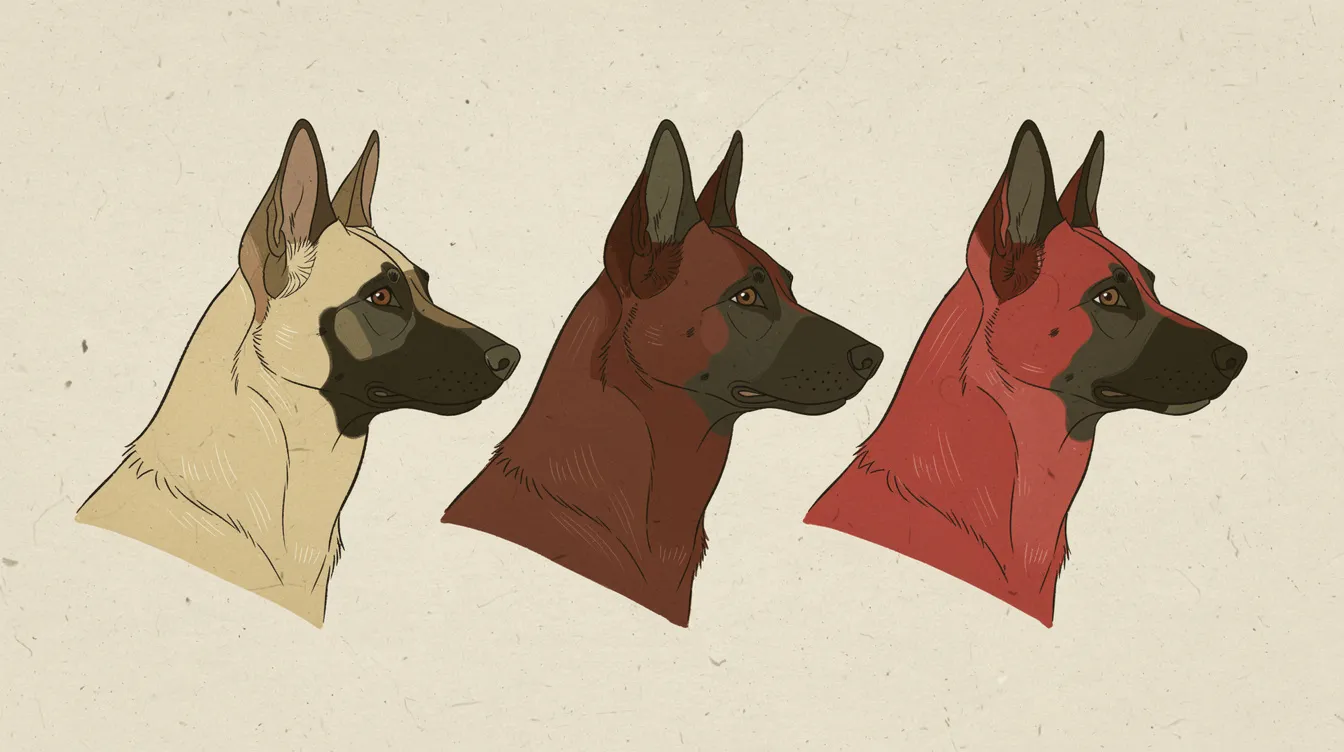
The Malinois has a fairly narrow, well-defined colour range compared to many breeds, which is part of what gives it such a recognisable look — but there's more variation within that range than people expect, and a fair amount of confusion with colours the breed doesn't actually come in.
Quick reference
| Colour | Recognised? | Notes |
|---|---|---|
| Fawn to mahogany, black overlay | Yes | The standard, recognised colour range |
| Red / deep red-mahogany | Yes | The darker end of the recognised range, sometimes called "red sable" |
| Sable | Yes (it's the same pattern) | "Sable" describes the black-tipped fawn/mahogany coat genetically — not a separate colour |
| Solid black | No | That's the Groenendael, a different Belgian Shepherd variety |
| Brindle | No | A common mix-up with the Dutch Shepherd, which is almost always brindle |
| White / cream | No | Very rare and not standard; usually linked to a dilute gene rather than typical breeding |
| Blue / grey (dilute) | No | A diluted, non-standard colour occasionally seen from unplanned genetics |
The base colours
Breed standards recognise a range from a rich fawn (a light tan) through mahogany (a deeper, more reddish tan) to a darker red, always overlaid with black tipping on the coat and a black mask across the muzzle. The overall effect is a warm, reddish-brown dog with a distinctly dark face — this combination is one of the breed's most recognisable features.
Are there black Belgian Malinois?
Not in the sense of a solid black coat — that's a different variety of Belgian Shepherd, the Groenendael, which has always been bred separately for a solid black, long coat. What people are often picturing when they ask this is a very heavily black-overlaid mahogany Malinois, where the black tipping is dense enough through the body coat to look almost black from a distance, especially in photos or dim light. Looked at closely, or in full sunlight, the underlying reddish-mahogany base colour is still visible.
What about brindle Malinois?
Brindle (a striped mix of colours) is not part of the Malinois breed standard at all — this is one of the most common colour mix-ups, usually because people are cross-shopping with the Dutch Shepherd, a closely related breed that's almost always brindle. See our piece comparing the two breeds if you're trying to work out which one you're actually looking at.
The black mask and overlay
A correct Malinois has visible black shading across the muzzle extending up around the eyes and ears, along with black-tipped guard hairs scattered through the coat, especially along the back and around the ears. The amount of black overlay varies between individuals — some dogs show heavier black shading through the body coat, others a lighter overlay with color concentrated mainly at the mask and ear tips.
Markings
A small white patch on the chest and white on the tips of the toes are both permitted in the breed standard and reasonably common; larger white markings elsewhere are generally considered a fault in conformation showing, though they have no bearing on health or temperament.
How this compares to other Belgian Shepherd varieties
The Malinois is one of four Belgian Shepherd varieties recognised in most countries — alongside the Groenendael (solid black, long coat), Tervuren (fawn to mahogany with black overlay, long coat), and Laekenois (fawn, rough/wiry coat). All four are the same underlying breed in some kennel club systems, differentiated by coat type and colour, which is why you'll sometimes see a Malinois-type dog registered simply as a "Belgian Shepherd."
Colour and temperament
There's no reliable evidence linking coat colour or the depth of the black overlay to temperament or working ability in the Malinois — line, breeding for temperament, and individual dog matter far more. Colour is a cosmetic breed-standard detail, not a meaningful predictor of the dog you'll actually live with. If anything, an unusual or non-standard colour (very pale, unusually dark, or a dilute shade) can sometimes be a sign of unplanned or non-standard breeding, which is worth asking a breeder about directly rather than assuming it reflects a "rare" or premium variation — reputable breeders generally aren't chasing novelty colours, since they aren't part of what the breed is selected for.
Quick answers
What colors do Belgian Malinois come in?
Fawn to mahogany to red, always with a black overlay and black mask. That's the full recognised range — solid black, brindle, and white are not part of the standard.
Are black Belgian Malinois rare?
True solid black isn't part of the Malinois standard at all — that coloring belongs to the Groenendael variety. A heavily black-overlaid mahogany Malinois can look nearly black, especially in photos, but isn't genetically the same as a solid black coat.
Do Belgian Malinois come in brindle?
No — brindle is not recognised in the Malinois standard. It's a common mix-up with the Dutch Shepherd, a closely related breed that's almost always brindle-coated.